
News
December 03, 2025
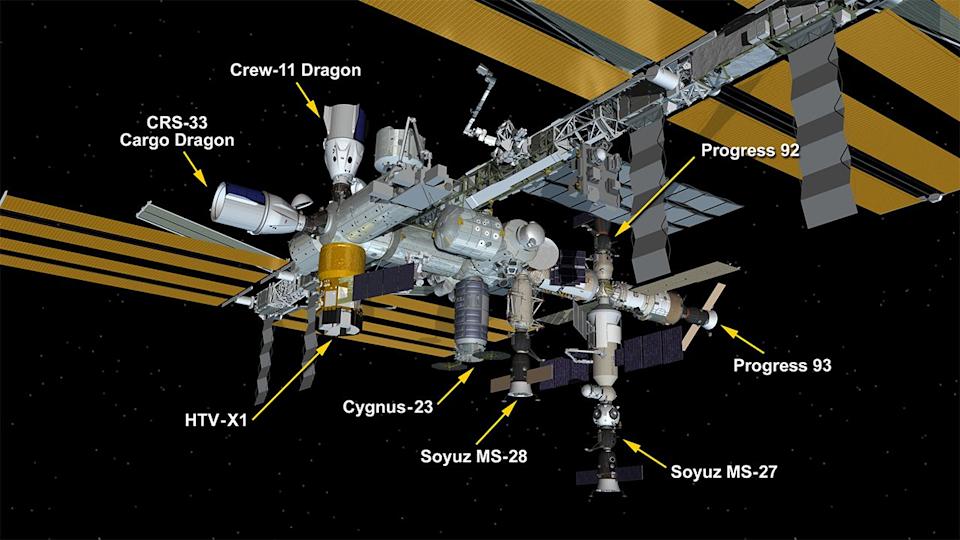
For the 1st time ever, 8 spacecraft are docked to the International Space Station
All eight of the International Space Station's docking ports are currently occupied by visiting spacecraft, marking a milestone for crewed spaceflight.
**A Full House in Orbit: International Space Station Reaches Docking Capacity**
In a historic first for crewed spaceflight, the International Space Station (ISS) is currently operating at full capacity, with all eight of its docking ports occupied by visiting spacecraft. This unprecedented situation signifies the increasing reliance on the ISS for scientific research, international collaboration, and commercial activity in low Earth orbit.
The presence of eight spacecraft simultaneously docked to the ISS represents a complex logistical achievement. Each visiting vehicle plays a crucial role in supporting the station's ongoing operations. These spacecraft are responsible for delivering essential supplies like food, water, and equipment to the astronauts on board. They also serve as transportation for crew members, enabling them to travel to and from the ISS. Some are even dedicated solely to research, bringing up experiments and returning samples to Earth for analysis.
The diverse fleet of docked spacecraft highlights the international nature of the ISS program. Space agencies from various countries, including the United States, Russia, Europe, and Japan, contribute to the station's operations and utilize its unique capabilities. This collaborative spirit has been instrumental in the ISS's success and its ability to push the boundaries of scientific knowledge.
While the full complement of docked spacecraft presents exciting opportunities, it also poses logistical challenges. Mission controllers on Earth must carefully coordinate the arrival and departure of each vehicle, ensuring the safety and stability of the ISS. Managing the flow of supplies and crew members requires meticulous planning and precise execution.
This milestone underscores the vital role the ISS plays in advancing space exploration and scientific discovery. As more nations and private companies look to the space station for research and commercial opportunities, the demand for docking ports is likely to increase. This historic moment serves as a testament to the ingenuity and dedication of the engineers, scientists, and astronauts who have made the International Space Station a beacon of international collaboration in the vast expanse of space. It also highlights the growing importance of space infrastructure as humanity expands its presence beyond Earth.
In a historic first for crewed spaceflight, the International Space Station (ISS) is currently operating at full capacity, with all eight of its docking ports occupied by visiting spacecraft. This unprecedented situation signifies the increasing reliance on the ISS for scientific research, international collaboration, and commercial activity in low Earth orbit.
The presence of eight spacecraft simultaneously docked to the ISS represents a complex logistical achievement. Each visiting vehicle plays a crucial role in supporting the station's ongoing operations. These spacecraft are responsible for delivering essential supplies like food, water, and equipment to the astronauts on board. They also serve as transportation for crew members, enabling them to travel to and from the ISS. Some are even dedicated solely to research, bringing up experiments and returning samples to Earth for analysis.
The diverse fleet of docked spacecraft highlights the international nature of the ISS program. Space agencies from various countries, including the United States, Russia, Europe, and Japan, contribute to the station's operations and utilize its unique capabilities. This collaborative spirit has been instrumental in the ISS's success and its ability to push the boundaries of scientific knowledge.
While the full complement of docked spacecraft presents exciting opportunities, it also poses logistical challenges. Mission controllers on Earth must carefully coordinate the arrival and departure of each vehicle, ensuring the safety and stability of the ISS. Managing the flow of supplies and crew members requires meticulous planning and precise execution.
This milestone underscores the vital role the ISS plays in advancing space exploration and scientific discovery. As more nations and private companies look to the space station for research and commercial opportunities, the demand for docking ports is likely to increase. This historic moment serves as a testament to the ingenuity and dedication of the engineers, scientists, and astronauts who have made the International Space Station a beacon of international collaboration in the vast expanse of space. It also highlights the growing importance of space infrastructure as humanity expands its presence beyond Earth.
Category:
Technology