
News
November 21, 2025
Rethinking where language comes from: Framework reveals complex interplay of biology and culture
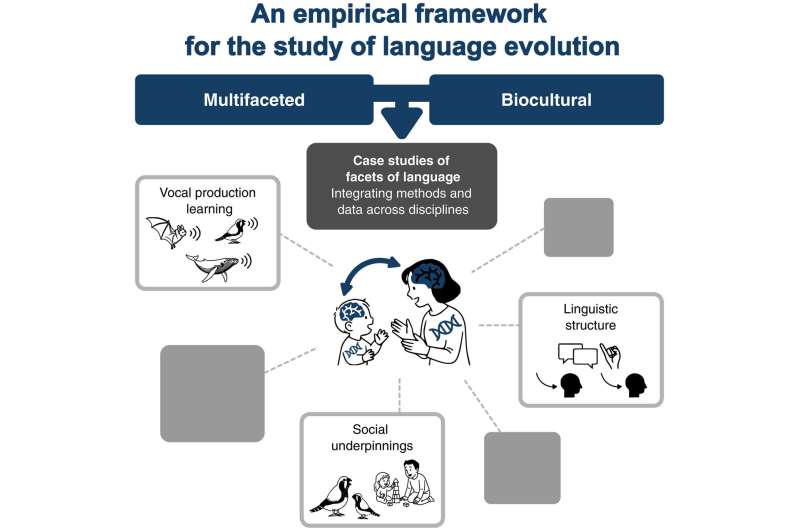
A new study challenges the idea that language stems from a single evolutionary root. Instead, it proposes that our ability to communicate evolved through the interaction of biology and culture, and involves multiple capacities, each with different evolutionary histories. The framework, published in Science, unites discoveries across disciplines to explain how the ability to learn to speak, develop grammar, and share meaning converged to create complex communication.
**Rethinking where language comes from: Framework reveals complex interplay of biology and culture**
Is language a gift from a single, ancient ancestor, or something far more intricate? A groundbreaking new study published in the journal *Science* suggests the latter, challenging long-held assumptions about the origins of human language. The research proposes a revolutionary framework that positions language not as a singular evolutionary development, but as a complex tapestry woven from the threads of biology and culture.
For years, scientists have debated whether language arose from a single, pivotal moment in human evolution. This new framework turns that idea on its head, arguing that our capacity for communication is the result of numerous abilities converging over time. These abilities, each with its own distinct evolutionary path, include the aptitude for learning to speak, the development of grammar, and the critical skill of sharing meaning.
The study highlights that language isn't just about having the physical ability to produce sounds. It's a multifaceted system that depends on our innate cognitive capabilities interacting with the cultural environment we're raised in. Children, for example, aren't simply born knowing how to speak English or Spanish. They possess the biological potential to learn language, but the specific language they acquire is entirely determined by their cultural context.
This new framework integrates findings from diverse fields, including genetics, neuroscience, linguistics, and anthropology. By uniting these perspectives, researchers are beginning to paint a more comprehensive picture of how humans developed the remarkable ability to communicate complex ideas, share knowledge, and build societies.
The implications of this research are far-reaching. It encourages a shift in how we study language, moving away from the search for a single "language gene" and towards understanding the intricate interplay between our biological inheritance and cultural experiences. Ultimately, this new perspective offers a richer and more nuanced understanding of what makes us human and how we came to possess the uniquely human gift of language.
Is language a gift from a single, ancient ancestor, or something far more intricate? A groundbreaking new study published in the journal *Science* suggests the latter, challenging long-held assumptions about the origins of human language. The research proposes a revolutionary framework that positions language not as a singular evolutionary development, but as a complex tapestry woven from the threads of biology and culture.
For years, scientists have debated whether language arose from a single, pivotal moment in human evolution. This new framework turns that idea on its head, arguing that our capacity for communication is the result of numerous abilities converging over time. These abilities, each with its own distinct evolutionary path, include the aptitude for learning to speak, the development of grammar, and the critical skill of sharing meaning.
The study highlights that language isn't just about having the physical ability to produce sounds. It's a multifaceted system that depends on our innate cognitive capabilities interacting with the cultural environment we're raised in. Children, for example, aren't simply born knowing how to speak English or Spanish. They possess the biological potential to learn language, but the specific language they acquire is entirely determined by their cultural context.
This new framework integrates findings from diverse fields, including genetics, neuroscience, linguistics, and anthropology. By uniting these perspectives, researchers are beginning to paint a more comprehensive picture of how humans developed the remarkable ability to communicate complex ideas, share knowledge, and build societies.
The implications of this research are far-reaching. It encourages a shift in how we study language, moving away from the search for a single "language gene" and towards understanding the intricate interplay between our biological inheritance and cultural experiences. Ultimately, this new perspective offers a richer and more nuanced understanding of what makes us human and how we came to possess the uniquely human gift of language.
Category:
Technology