
News
December 04, 2025
Malaria parasites corkscrew their way deeper through skin
Malaria sporozoites injected into human skin have to cover hundreds of micrometres to find a capillary that leads them to the liver. Older geometric models had already hinted that the natural distance across which a parasite makes a turn roughly matches the radius of small blood vessels, making it easier to loop around them
**Malaria Parasites Corkscrew Their Way Deeper Through Skin**
Scientists have gained new insights into the remarkable journey malaria parasites undertake after entering the human body, revealing a fascinating "corkscrew" motion that helps them navigate through the skin to reach the bloodstream. The discovery sheds light on the crucial early stages of malaria infection and could potentially pave the way for new strategies to prevent the disease.
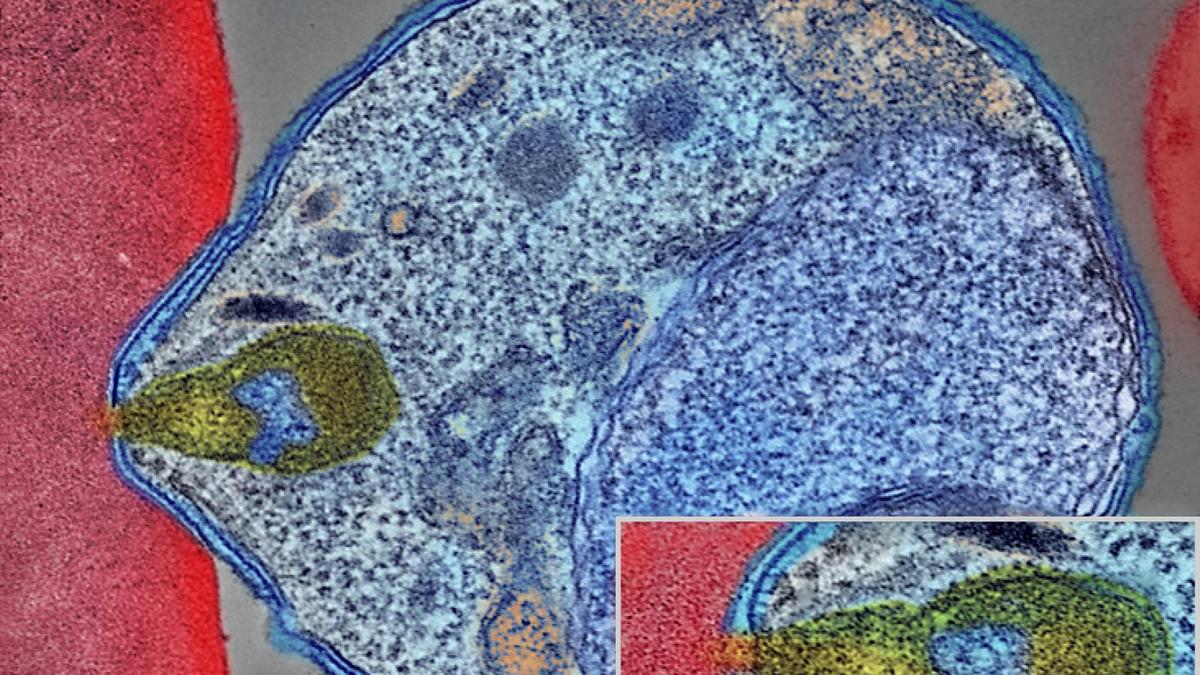
Malaria is caused by parasites transmitted to humans through the bite of infected mosquitoes. When a mosquito injects these parasites, known as sporozoites, into the skin, they face a significant challenge: they must travel hundreds of micrometers to find a tiny capillary, a small blood vessel, that will carry them to the liver, their next target.
Previous research had suggested that these parasites don't just move in a straight line. Now, scientists are uncovering the intricate details of their movement. They found that the sporozoites use a corkscrew-like motion to burrow through the dense tissue of the skin. This spiraling path isn't random; it appears to be a highly efficient strategy for finding blood vessels.
Interestingly, earlier models had hinted at a crucial connection between the parasite's turning behavior and the size of blood vessels. The distance across which a parasite naturally makes a turn roughly matches the radius of these small capillaries. This suggests that the parasites are essentially "programmed" to loop around these vessels, making it easier for them to encounter and enter them.
This new understanding of the parasite's movement through the skin has important implications for malaria prevention. By understanding how the sporozoites navigate, researchers can potentially develop interventions that disrupt their journey. This might involve creating drugs or therapies that interfere with their corkscrew motion, making it harder for them to reach the bloodstream and ultimately preventing the infection from taking hold. Further research is needed to fully exploit this knowledge, but the discovery offers a promising new avenue for combating this deadly disease.
Scientists have gained new insights into the remarkable journey malaria parasites undertake after entering the human body, revealing a fascinating "corkscrew" motion that helps them navigate through the skin to reach the bloodstream. The discovery sheds light on the crucial early stages of malaria infection and could potentially pave the way for new strategies to prevent the disease.
Malaria is caused by parasites transmitted to humans through the bite of infected mosquitoes. When a mosquito injects these parasites, known as sporozoites, into the skin, they face a significant challenge: they must travel hundreds of micrometers to find a tiny capillary, a small blood vessel, that will carry them to the liver, their next target.
Previous research had suggested that these parasites don't just move in a straight line. Now, scientists are uncovering the intricate details of their movement. They found that the sporozoites use a corkscrew-like motion to burrow through the dense tissue of the skin. This spiraling path isn't random; it appears to be a highly efficient strategy for finding blood vessels.
Interestingly, earlier models had hinted at a crucial connection between the parasite's turning behavior and the size of blood vessels. The distance across which a parasite naturally makes a turn roughly matches the radius of these small capillaries. This suggests that the parasites are essentially "programmed" to loop around these vessels, making it easier for them to encounter and enter them.
This new understanding of the parasite's movement through the skin has important implications for malaria prevention. By understanding how the sporozoites navigate, researchers can potentially develop interventions that disrupt their journey. This might involve creating drugs or therapies that interfere with their corkscrew motion, making it harder for them to reach the bloodstream and ultimately preventing the infection from taking hold. Further research is needed to fully exploit this knowledge, but the discovery offers a promising new avenue for combating this deadly disease.
Category:
Technology